
‘I Felt the Landscape Screaming Through the Music’:
Metal, Nature, & Environmentalism
This is the draft introduction to a scholarly article currently under consideration by Metal Music Studies journal. Check back later for, hopefully, a link to the full article or get in touch if you’d like to be sent a draft.

‘A blastbeat to me is like water. Maybe others think of it as something really tough and hard. It feels like a waterfall to me, like crying really hard’.
Maria Stocke, Ragana (Revolver Magazine, 2019)
‘Blood, bile, intracellular fluid; a small ocean swallowed, a wild wetland in our gut, rivulets forsaken making their way from our insides to out, from watery womb to watery world: we are bodies of water’.
Astrida Neimanis, (Bodies of Water, 2017)
Metal has often been associated with post-industrial landscapes and mechanized aggression. From the beginning of metal studies, scholars used urban alienation and industrial excess to frame the genre’s development (Weinstein: 1991; Bogue: 2004; Moore: 2016). Recent writing has explored how metal’s aesthetics promote self-realisation, embodying traditional humanist values of power over self, others, and the natural world (Gamble: 2021). These are values directly opposed to current environmentalist thought. Only the pine forests of black metal have consistently been interpreted as exceptions to this urban norm. Yet they too have been read as expressing the values of humanist modernity, because of the vision of an ‘aristocracy of the soul’ that lay behind Norwegian black metal’s retreat from the city (Lukes & Panayatov: 2023). A tiny number of bands have been recognised as offering alternative engagements with the environment. Gojira and Wolves in the Throne Room (WitTR) have been presented as isolated exceptions whose environmental consciousness is an unlikely departure from metal’s core ideals and aesthetics (Seifert & Murray: 2012).
These framings can’t account for the work of thousands of musicians who use metal to pursue deep engagement with nature, wilderness, and environmentalism. A huge range of post-humanist and anti-humanist outlooks can now be found across all subgenres and all continents. Many bands’ ties to activist movements and embrace of anti-extractivist, off-grid, living, alongside the rapidly growing influence of indigenous metal, make this engagement far from casual or performative. An increasing number of bands embrace the drastic career consequences of principles like refusing to fly for touring. Metal’s current creative flourishing is generating new kinds of engagement with elemental forces, non-human species, and both pre-modern and non-Western ontologies of nature. This article explores how musicians articulate relationships with rural space, ecological crisis, and the natural world. It shows that metal’s traditional origin stories and interpretations of ethics and aesthetics tell only a few of the genre’s many potential narratives.
One undercurrent of this study is the role of water as imagery in contemporary metal. This takes the form of oceans, storms, floods, marshes, streams, springs, fog, sweat, and tears. It is aesthetic inspiration, imagined conduit between states of being, symbol of individual catharsis, and medium of Gaian self-defence against the Promethean flame of industrial humanity. Where ice defined black metal in eras shaped by fear of nuclear winter, concern for climate warming has added melt to metal’s imagery. The ideas of Astrida Neimanis, in Bodies of Water (2017) and ‘Weathering’ (2013), are powerful tools for interpreting these watery ties between music and environment. Neimanis’s evocation of a ‘hydrocommons’, which envisions socially and ecologically conscionable ways of being beyond humanist ontologies, has a surprising range of echoes in metal’s anti-humanistic perspectives. Their development has coincided with dramatic diversification in metal’s emotional associations. As the quote from Maria Stocke, above, indicates, there’s increased space for vulnerability, anxiety, and grief, as well as power and rage, in metal’s growing affective range. This amounts to new ways in which metal has been adapted to help musicians and fans process the emotional turmoil of an era of climate breakdown. It underpins one of this article’s key arguments: that contemporary metal is now more amenable to posthumanist than modernist or humanist modes of analysis.
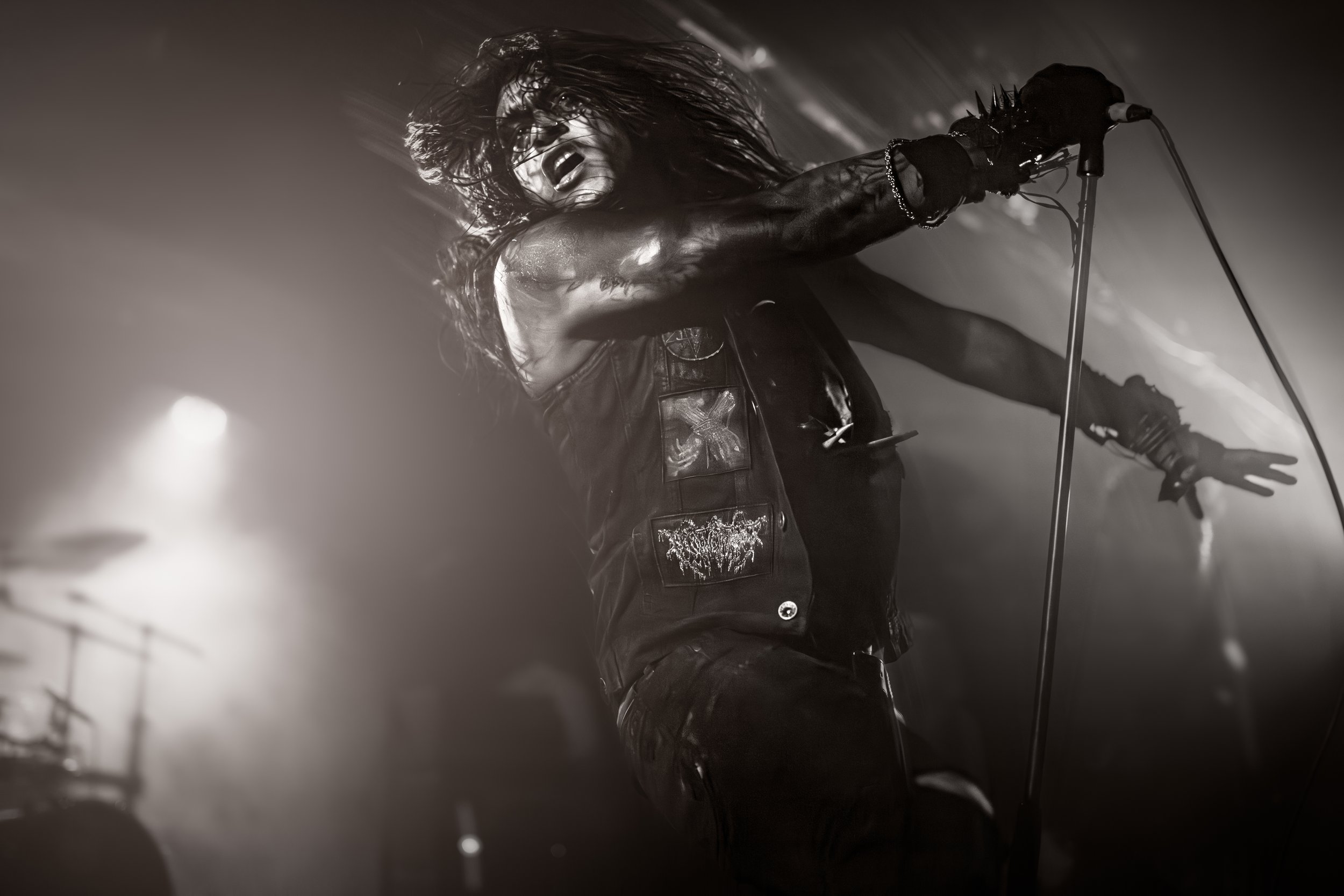
Blackbraid (Asylum, Birmingham, 2026)
This study originates from field research around the North Atlantic. That research wasn’t initially about music: it explored relations with environment and place embodied in the building of traditional wooden boats. But it profoundly shaped the form this study takes. In 2022-24, the project involved spells in numerous small coastal communities. These ranged from the West of Ireland to Northern Sápmi and West Greenland (Gange: 2026a). Each settlement was a stop on journeys in small rowed or paddled boats, with routes calculated to study the interactions with seascapes they facilitated. Time ashore was spent assisting in boat workshops. This exposure to coastal life generated many surprises, including the music that blared from stereos in the workshops. This was occasionally the folk that might, casually, be expected. But far more often it was contemporary metal.
Beyond the workshops, remarkable numbers of the people I talked to or travelled with – people who crossed my path because of their commitment to community, place, heritage, and environment – were metal musicians or otherwise invested in the music. Some spoke as though links between rugged rural coastlines, marginalized communities, environmental activism, and metal were obvious and even natural. When they reeled off names of ecologically-committed and activist metallers - from Agruss to Unearthly Rites - I began to compile a list of bands whose work engaged with environmentalist aesthetics and the anti-extractive grassroots politics of rural coastlines.
By the time I returned home, my list was nearly three-hundred strong. Building a parallel bibliography, I found that black metal, death metal, metalcore, and grindcore have each been labelled ‘the music of the Anthropocene’ (Morton: 2013; Snaza & Netherton: 2016). I noticed things I’d not been primed for before, including the fact that scholarship rarely conjures the atmosphere of crowds and live performance without nature, place, and environment as metaphor and imagery. A recent study of how metal facilitates empowerment, for instance, opens with an imagined wilderness storming the inner-city space of the mosh pit:
All around you – with you – allies seem to weather the storm, resilient raindrops in a squall of sonic power. Or maybe you face the gale alone at this moment, but you know you are part of something much bigger. This is your storm, after all. (Gamble: 2021, 1).
The language of weather and wilderness is as inescapable when reading of metal’s affects as in environmentalist theory, but there has been no analysis of its functions.
I thought back to experiences of live music. I saw, for instance, the Irish band Primordial tour in support of their album The Gathering Wilderness (2006). Facing away from the crowd, as floor toms pummeled like pelting raindrops, the band opened with the lines ‘One day, I stood with my back to the wind/And the rain fell down’. The roar from the crowd swept, like incoming weather, across the pitch-black space. By the time, fifteen minutes later, they sang ‘The Wilderness is gathering all its children in’, smoke machines simulated a cloud-bound mountain peak. The music, like the stormy imagery with which scholarship conjures metal’s crowds, seemed to assume that part of metal’s purpose is spatial dislocation: an imaginative translation to somewhere weather-whipped and wild.
I found numerous interviews in which musicians conceptualized metal’s aesthetics as rural, environmental, and wet. These often figure nature as active, emotionally charged, and a context for human futures rather than, as in early black metal, a retreat from the present. The quote from Maria Stocke, above, exemplifies ways in which metal’s techniques have undergone shifts in meaning: the machine-like barrage of the blastbeat is now often described without reference to aggression or hostility but, instead, as organic and overwhelmingly sad (Mandel: 2019). Other interviews, from the same time, reveal the infamously exclusive codes of belonging in some scenes shifting: ‘if you listen to Black Metal’, said Aaron Weaver of WitTR, ‘but you don’t know what phase the moon is in or what wildflowers are blooming, then you have failed…the music is about wild forests, unfettered rivers, nature: furious and vengeful’ (Brown: 2018).
I realised that when Weaver spoke of black metal as a ‘spiritual undercurrent to our world’, the word ‘undercurrent’ was as significant as the term ‘spiritual’. The clear streams and life-giving springs of his lyrics nurture a vision of natural forces cognate with Dylan Thomas’s ‘force that through the green fuse drives the flower’: marginal background processes, rather than cataclysmic drama, reformulate everything (Thomas: 1934). In its North-American forms, this phenomenon is shaped by musicians’ encounters with indigenous thought and is the opposite of the romantic wilderness discourse, as defined by scholars such as William Cronon, with which scholarship has associated metal’s rural spaces (Collinson, 2019).
I read interviews from scenes seemingly distant from the pine-scented metal of America’s Pacific Northwest, such as British death metal and grindcore. Here, fans credit pioneers of the early scene, including Carcass and Napalm Death, as inspiration for environmental consciousness. These bands shaped today’s thriving Environmental Vegan Death Metal (EVDM) scene which expresses distinctive forms of anti-humanism. I thought of bands who’ve appeared onstage with environmentalists such as Paul Watson, and campaigned for organisations like Sea Shepherd who make metal their signature soundworld.
Experiencing North-Atlantic metal scenes drove home three things. First, that environmentalism is far from marginal to modern metal. Second, that metal is central to modern environmental activism. And third, that environmentalism now cuts across genre divides: some fans and musicians pursue eco-metal as a trans-generic scene that cross-fertilises punk, hardcore, black metal, grindcore, metalcore, as well as death, doom, black and progressive metals.
Musicians and fans across the whole eco-metal spectrum are now engaged in pursuing what new materialist theorists such as Donna Haraway and Karen Barad call ‘Worlding’: building answers to the question ‘what kind of worlds are needed at this time of ecological crisis?’ (Haraway: 2016; Barad: 2007, 396). Haraway and Barad recognise that a fundamental challenge of living through climate collapse is finding productive ways to process anxiety, anger, loss, and uncertainty. They also emphasise that such a condition must generate alternatives to Enlightenment humanism. Recognising the sheer amount of metal that isn’t urban in origin and evocation, or humanist and individualist in outlook, is a step towards further cross-pollination of heavy music and environmentalist outlooks.
After exploring the environmentalist possibilities of assuming that not just the city but also wild, wet, and rural spaces are part of mainstream metal’s imaginary, subsequent sections of this article situate different genres in relation to environmentalism and perceptions of the natural world: first, black metal; then death metal and grindcore; followed by progressive metal and metalcore. The latter section uses a case study from the Faroes to show how disputes which have been conceptualised as pitching environmentalist versus anti-environmentalist perspectives are in fact debates about the nature of environmentalism: contrary to general perception, bands on all sides are invested in ecology. The final section uses Neimanis to explore shifting ontologies and ‘worldings’ in metal’s flowing water, rain, and fog.

Wolves in the Throne Room (St Luke and the Winged Ox, Glasgow, 2026)